How Much Water Does AI Use per Prompt?
AI water use per prompt varies by model, cooling system, and power source. See the range, what shapes it, and why local water stress matters.

Understanding Water Use by AI
How much water does AI use per prompt? Estimates range from about 0.0005 to 1.5 gallons. That wide span is not a fixed rate for every question. The answer depends on the model, data center, power source, and what the estimate counts.
Most water tied to AI supports the data centers that run its models. Some water cools servers on site. More may be used to make the electricity that powers them. So, asking how much water one AI prompt uses means asking which parts of that chain count.
Water withdrawal and water use are not the same thing. A data center may draw water and return some of it later. Water that evaporates during cooling is consumed and does not return to that source right away. That difference matters in places with tight water supplies.
A short text request usually needs less computing work than a long answer or an image request. The amount also shifts with the model and where it runs. One average cannot capture every task.
What Shapes the Water Use of a Prompt?
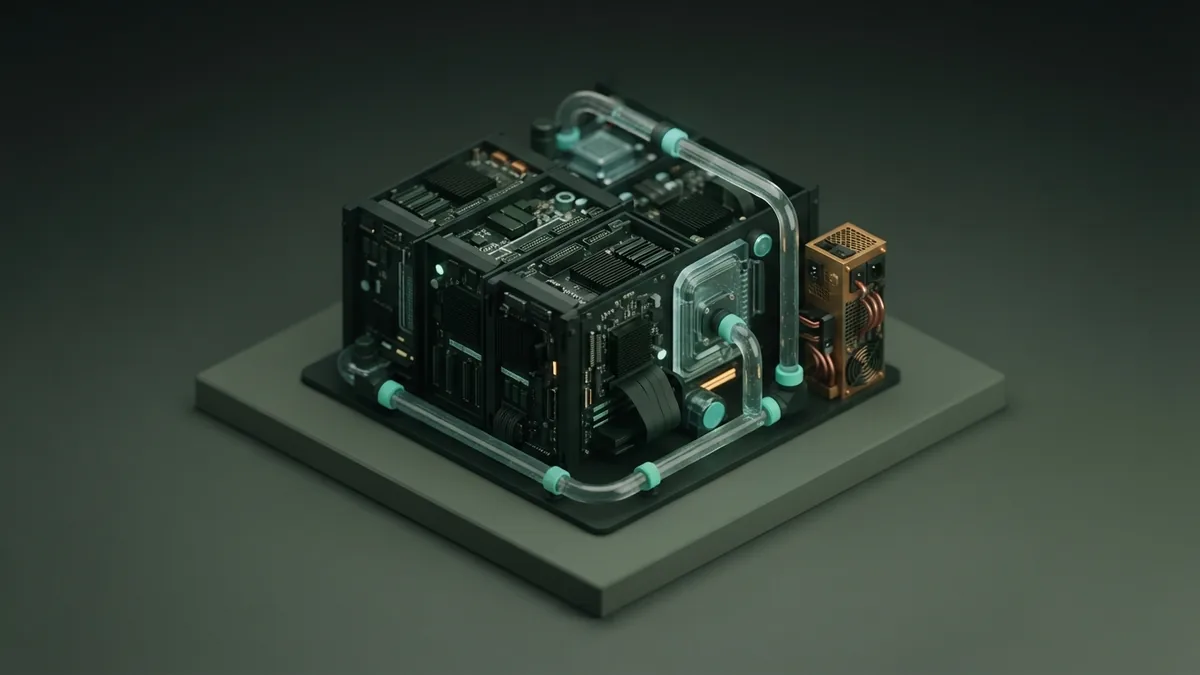
Data center cooling is a major factor in the water footprint linked to AI. Some sites use water-based cooling. Others rely more on air or closed-loop systems. A closed loop reuses coolant, but the site may still need water for other tasks.
Weather and season can change cooling needs. A hot, dry day may raise water use at some sites. Location matters, too. Local water supplies, cooling systems, and power grids all differ.
- Model size: Larger models often need more computing power for each answer.
- Prompt and answer length: More text can mean more processing.
- Cooling system: Site design shapes direct water use.
- Power source: Some forms of electricity need water to produce.
- Time and place: Weather, grid mix, and local demand shift over time.
Power use adds another layer. Some power plants use water to make steam or cool equipment. Wind and solar power tend to use less water while running. Yet each power source has a wider footprint across its full life cycle.
Two matching prompts can therefore have different water footprints. They may run at sites with different cooling systems or use power from different grids. The prompt alone does not show those details.
Estimated Water Use for One AI Prompt

As noted above, estimates range from about 0.0005 to 1.5 gallons per prompt. The low end is a small fraction of a gallon. The high end should not be read as a typical result for every text request.
A study by Shaolei Ren and co-authors estimated that GPT-3 could use about 500 milliliters for 10 to 50 medium-length responses. The result varied by place and time. That equals roughly 0.003 to 0.013 gallons per response. The research paper on AI’s water footprint explains its method and limits.
This study does not set a universal rate. It covers one model and a set of stated assumptions. Newer models, longer answers, and other data centers can change the result.
There is no public meter that tracks the water used by each prompt across all AI services. Providers may not share site-level water and power data. So, asking how many gallons of water one AI prompt uses has no single exact answer.
People sometimes compare AI’s water use with a bottle of drinking water. That can help show scale, but it can also mislead. A small prompt estimate may be far below one bottle, while a high estimate can be much larger. The range changes with the assumptions, so bottle counts are rough comparisons, not fixed facts.
Environmental Effects of AI Water Use

Water use matters most where local supplies are already under stress. A small amount per prompt can add up when millions of prompts run each day. Large models also need power for training and daily use.
Water is only one part of AI’s environmental impact. Power demand can cause emissions, depending on the grid. Data centers also need land, hardware, and raw materials. A fair view tracks these costs together.
For nearby communities, the key question is often where and when water is used. A gallon consumed in a water-rich area has a different local effect than one used during a drought. Better reporting should name the region, water source, and time span.
Clear data can help firms choose sites and cooling systems with care. It can also help customers compare services without relying on one headline number. The goal is to cut avoidable waste while meeting local needs.
How AI Compares With Other Technologies

AI is not the only digital service that uses water. Traditional computing, cloud storage, video streaming, and web searches all rely on data centers and power grids. Their water footprints also depend on cooling and energy sources.
It is hard to compare one AI prompt with one web search or streaming session. Each task uses different hardware and runs for a different length of time. Public data also varies in scope. A sound comparison needs the same measures for each service.
Cloud services can host AI alongside many other workloads. Water used by a shared data center may support more than one service. That makes it hard to assign every drop to one prompt or product.
Look for figures that state what they count. Good estimates name the model, site or region, time span, and whether they include power generation. Without those details, comparisons can make small differences seem certain.
What Could Improve AI Water Efficiency?
Data center operators can cut water demand through better cooling design and site choice. They can also match workloads to times and places with lower water stress. No single fix works for every climate or facility.
More efficient models may need less computing power for a given task. That can lower energy demand and, in turn, some water use tied to power. Yet efficiency can also make AI cheaper to use, which may increase total demand.
Better reporting is part of the answer. Firms can share water use by site, cooling type, and season. They can also state whether figures cover direct cooling, power generation, or both. That gives communities and users a fair basis for judging claims.
AI can support useful work, but its resource use still counts. Careful measurement helps teams weigh benefits against water and energy needs. It also points to the changes that can reduce harm.
Frequently asked questions
- How much water does one AI prompt use?
- Estimates range from about 0.0005 to 1.5 gallons per prompt. The figure depends on the model, data center, cooling system, and power source.
- How many gallons of water does an AI prompt use?
- There is no single exact amount. One study estimated about 0.003 to 0.013 gallons for a medium-length GPT-3 response under its stated conditions.
- Does AI use water directly?
- Some data centers use water to cool servers. More water may be used to produce the electricity that powers them.
- How many bottles of water does AI use per prompt?
- A bottle comparison is only a rough way to show scale. Prompt estimates vary widely, and the amount can be far below one bottle or much higher.
- Why does AI water use vary so much?
- Models, answer length, cooling design, local weather, and power grids all affect water use. Estimates also differ in whether they count power generation.
Related reading

How to Use Chat Memory in Janitor AI
Learn how Janitor AI Chat Memory works, how to connect OpenAI, write useful memory notes, and fix common setup and chat problems.

Testing Multi-Provider Payment Routing: Failover, Idempotency and Reconciliation
A deep technical guide to testing payment routing cascades, provider failover, idempotency keys, webhook ordering, 3DS states, refund flows and CI test matrices for multi-acquirer checkout systems.

What Is an AI Hallucination? Meaning and Examples
Learn what AI hallucinations are, why they happen, how to spot them, and what teams can do to reduce false claims and protect user trust.