Seed AI Framework: What It Is, Features, and Future
Learn what Seed AI is, its key features, history, comparisons, real use cases, and why researchers still have no Seed AIs.

What is Seed AI?
Seed AI is a proposed path to Artificial General Intelligence (AGI) that can recursively improve its own source code without human intervention. In plain terms, it starts with minimal intelligence and then grows by modifying the system that produced its thinking. So if you are asking, “what is seed framework in ai,” the best answer is that it is a self-improving design for an eventual AGI system.
The concept was coined by Eliezer Yudkowsky. It uses the idea of a “seed”: a small, capable enough starting point that can bootstrap into stronger abilities over time. That bootstrapping is not just learning from data. It is also changing the program that performs the learning.
In Seed AI, the system is expected to understand its own source code, syntax, and architecture. It should then use that understanding to reflect on what it is doing and what to change. That is why source rewriting is such a central theme.
Some people also ask whether a Seed AI is an “agentic ai framework.” It overlaps in spirit with agentic ideas, because both involve goal-directed behavior. But “Seed AI” is more specific. It focuses on recursive self-improvement at the code level.

Key features of a Seed AI system
Seed AI is often described as a self-reflection loop over software artifacts. The system does not only reason about the outside world. It also reasons about its own internal structure. That is what enables self-reflection in AI to be applied to the machine itself.
Source code understanding is a key feature. The system needs enough competence to parse its program. Then it needs enough structure-awareness to modify the right parts. Without that, code rewriting becomes guesswork instead of engineering.
Another core feature is code rewriting. The ability to rewrite its own source code matters because it allows continuing improvement in new areas. If the system can change how it learns, updates, or searches, it can keep raising its ceiling.
Below is a compact way to see what “recursive self-improvement” means in Seed AI terms.
- Self-modeling: Understand its own modules, inputs, and outputs.
- Syntax-level access: Read code structure, constraints, and interfaces.
- Reflective evaluation: Compare current behavior against goals.
- Program modification: Update code to reduce failure modes.
- Bootstrap persistence: Keep improving without human edits.
Seed AI is also tied to a broader line of ideas, including Recursive Self-Improvement and an “intelligence explosion” scenario. In those scenarios, improvements compound quickly. The worry is that the growth could outrun human oversight.
You might see “best agentic ai framework” discussed in agent tool-building circles. Seed AI is different. It is not just an agent that plans actions. It is an agent that plans changes to itself.

History and development
The most-cited origin point is Eliezer Yudkowsky’s work introducing the Seed AI idea. The framing was meant to capture a specific mechanism for AGI growth: recursive self-modification. It is a conceptual framework, not a released system.
After the coinage, the idea was connected to other theories of self-improving machines. One related concept is Gödel Machines, which formalize a method for a system to prove that a change improves its own objective. The connection is not exact, but both emphasize self-reference and self-modification.
Another related theme is Intelligence Explosion. That idea describes rapid capability growth driven by improved reasoning or faster learning. Seed AI is one candidate mechanism that could, in theory, lead to that kind of compounding.
It also overlaps with modern Machine Learning practice in one key area: learning loops. In normal ML, a model improves by training on data. In Seed AI, the system would also improve by editing its own code so future training changes too. That is a major shift in control flow.
So when people search “what is ai framework” or “what is agentic framework in ai,” Seed AI shows how frameworks can differ. Some frameworks are about orchestration and tools. Seed AI is about the control layer of the model itself.

Comparison with other AI frameworks
A common source of confusion is that “ai framework” is a broad term. In practice, it can mean software libraries for building systems. It can also mean architectural paradigms like agentic pipelines. Seed AI sits closer to the architectural paradigm end, because it describes a mechanism for growth.
Agentic AI frameworks aim to let an AI act toward goals. They often include planners, tool use, memory, and feedback. In that world, “what is agentic ai framework” is usually answered as a stack for running autonomous workflows. Seed AI overlaps with agentic AI only in that it uses an internal loop of reasoning and action.
For example, an agentic workflow might call external tools, run searches, or execute code in a sandbox. Seed AI goes further. It would edit the program doing the reasoning. That is a qualitatively different kind of autonomy.
Some readers also ask about “spring ai framework.” That phrase is commonly used in web development contexts, especially with Java ecosystems. It is not the same as Seed AI. Seed AI is a research concept about self-improving AGI mechanisms, not a software library name.
To make the distinctions concrete, consider the table below.
| Framework type | Main goal | How it improves | Self-change scope |
|---|---|---|---|
| Seed AI (concept) | Recursive AGI growth | Code rewriting plus learning | Internal source code |
| Agentic AI framework | Goal-directed tasks | Looped planning and tool feedback | Usually external actions |
| ML training pipeline | Prediction quality | Gradient updates on data | Parameters, not full code |
| Reasoning-only system | Answering queries | Static model behavior | No self-editing |
Finally, about “which of the following is a popular ai framework” or “which agentic ai framework is best,” be careful with rankings. Most “best” claims depend on the task: tool use, latency, safety, and cost. Seed AI is not in that same comparison set because no Seed AI systems exist publicly.
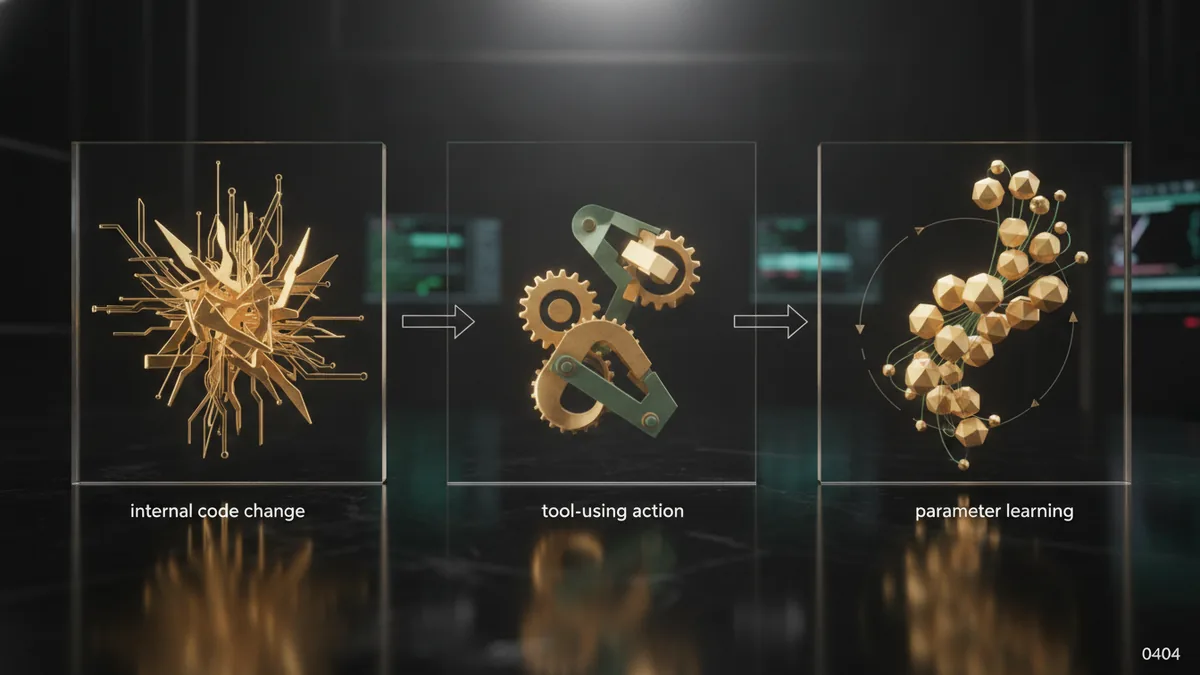
Practical applications of the Seed AI idea
Even without an actual Seed AI deployed, its mechanism suggests practical directions. You can build systems that do partial self-improvement under supervision. Then you can test how well the system understands its codebase. Those experiments can be framed as “self-reflection in AI” plus safe program change.
A realistic path is staged autonomy. First, build tools that let an AI inspect code and explain architecture. Next, add constrained refactors, like changing one module at a time. Then, move to automated testing and rollback. At each stage, you measure whether the system makes safe changes that improve outcomes.
Another application is using formalized self-checking. A Seed AI would need to verify that a rewrite preserves correctness and improves performance. In practice, teams use tests, static analysis, and property checks. Those checks are not as strong as full self-proofs, but they reduce catastrophic failures.
Below is a practical workflow you can use to explore Seed-like behavior in a controlled setting.
- Instrument the system: Log internal decisions, tool calls, and failure cases.
- Give code visibility: Provide the model with a structured view of modules and interfaces.
- Constrain edits: Restrict changes to a defined set of files or rewrite patterns.
- Require evidence: Demand test runs or benchmarks before accepting a change.
- Use rollback: Keep a “known good” version and revert on regressions.
- Track compounding: Measure improvement over many cycles, not one-off wins.
These steps do not create a Seed AI. They create a safer sandbox for exploring the same ingredients: self-understanding, reflective evaluation, and code-level improvement. Over time, you can study where the system breaks and what kinds of guidance make it stable.
Current research and future directions
Current research on Seed AI-like mechanisms is active across multiple organizations. Many groups are exploring recursive improvement, agentic loops, and tool-using autonomy. However, it is important to state the key reality: no Seed AIs exist yet that meet the full definition. In other words, no system has proven it can recursively improve itself by editing its own code without human intervention.
Research gaps are still large. The hardest part is not generating code. It is ensuring that edits preserve functionality and improve goals. Another gap is getting reliable self-understanding. Models may claim to know their architecture without truly tracking the constraints that matter.
Safety and evaluation are also central. If a system can change itself, you need stronger ways to limit what it can do. You also need a way to detect when the system is optimizing the wrong objective. This is where debates about governance and control become practical engineering questions.
Looking forward, future directions likely include tighter verification tooling and better objective alignment in self-improvement loops. Teams may also combine agentic frameworks with stronger sandboxes and formal checks. That could yield systems that approach Seed AI behavior without reaching the full “hands-off” recursion.
Seed AI is also a research compass. It helps people ask which abilities are prerequisites for AGI. If recursive self-improvement is ever real, it will likely rest on the ability to understand code, reason about consequences, and rewrite safely. Those are measurable milestones, not just philosophy.
FAQ: Seed AI framework
Q: What is seed framework in ai?
A: It is a proposed AGI approach where an AI can self-reflect and recursively improve by rewriting its own source code.
Q: Is Seed AI an agentic AI framework?
A: It overlaps with agentic ideas, but it is more specific. Seed AI focuses on self-improvement at the code level.
Q: Did Eliezer Yudkowsky create Seed AI?
A: Yes. He coined the “Seed AI” concept and described it as minimal intelligence that evolves over time.
Q: Do Seed AIs exist today?
A: No. Research is ongoing, but no public system fully matches the Seed AI definition.
Q: How is Seed AI related to Gödel Machines?
A: Both involve self-reference and self-improvement ideas. Gödel Machines use formal proofs for when to change the system.
Q: What is intelligence explosion in this context?
A: It is the scenario where upgrades compound rapidly. Seed AI is one possible mechanism that could lead to such growth.
Frequently asked questions
- What is Seed AI in artificial intelligence?
- Seed AI is a proposed AGI mechanism where a system can recursively improve itself by editing its own source code without human help.
- Who coined the Seed AI concept?
- Eliezer Yudkowsky coined the Seed AI idea and described it as starting from minimal intelligence that evolves.
- How does Seed AI understand its own source code?
- The concept assumes the system can parse its program structure and architecture, then use that understanding to decide what to change.
- Can Seed AI rewrite its own code, and why is that important?
- Yes, code rewriting is central because it allows ongoing improvement of how the system learns and reasons over time.
- Is Seed AI the same as an agentic AI framework?
- Not exactly. Seed AI is a specific self-improvement concept, while agentic frameworks mainly orchestrate goal-directed actions.
- Are there any Seed AIs in the world today?
- No. Research continues, but no system publicly meets the full Seed AI definition.
Related reading

What Is AI SaaS? How It Works and What to Look For
Learn what AI SaaS is, how cloud-based AI tools work, where teams use them, and what to check when choosing a provider or building a product.

What Is Temperature in an LLM? Settings and Uses
Learn what temperature does in an LLM, how it affects token choices, and how to tune it alongside top-p for reliable or creative text.

AI Development Tools for Product Teams
Explore AI development tools for research, design, coding, testing, and docs. Learn how product teams can choose tools and check their results.